Analyzing Paintings
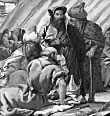 The
top illustration shows a detail from Domenico Tiepolo's
'An Oriental Encampment' (c. 1752. Landesmuseum.
Mainz). Why does it appear so attractive? To answer
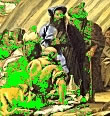
that, first look at the tones, the second illustration.
The first image has been exported into a simple
graphics program (Paintshop Pro) and converted to
a 256 grayscale image, a simple, one-click operation.
You will note how vigorous is the drawing and the
variety with which tones are distributed. Reducing
the image to a black and white illustration will
identify shapes, which are also revealing, though
not illustrated here.
The
top illustration shows a detail from Domenico Tiepolo's
'An Oriental Encampment' (c. 1752. Landesmuseum.
Mainz). Why does it appear so attractive? To answer
that, first look at the tones, the second illustration.
The first image has been exported into a simple
graphics program (Paintshop Pro) and converted to
a 256 grayscale image, a simple, one-click operation.
You will note how vigorous is the drawing and the
variety with which tones are distributed. Reducing
the image to a black and white illustration will
identify shapes, which are also revealing, though
not illustrated here.
Now focus on the orange-red tunic of the figure
in the foreground. It appears very localized, but
is nonetheless harmonious, coexisting well with
other colors. Part of the reason is the tone: it
balances well with similar tones, as the second
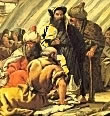
illustration indicates. But suppose we replace hues
similar to its orange-red with vivid green, so that
we can judge their full extend. Again, this is a
one click operation, and the results (third illustration)
are striking. Orange-red hues are widely distributed,
are indeed one the foundations of color composition.
We can analyze further. What color are the stripes
in the background awning — a brownish green?
Place the eyedrop tool on the color and check. Yes,
but closer to brown than you'd suppose. They appear
greenish by contrast, and the artist has again produced
variety without upsetting the color scheme. Many
other felicities of color can be explored by this
approach (and would be apparent in a larger illustration).
Tiepolo is inheriting not only his father's legendary
color skills, but two hundred years of Venetian
expertise.
Experimenting
 What
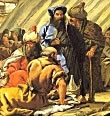
color scheme is being adopted in the detail? Broadly
a split complementary: blue in opposition to yellow-orange,
orange and orange-red. Suppose, however, that Tiepolo
wanted to change this scheme, and perhaps make it
closer to an analogous one. He replaces the blue
with yellow-orange: fourth illustration. The loss
is immediate: the figure doesn't stand out, and
the surrounding colors look dull and uninteresting.
What
color scheme is being adopted in the detail? Broadly
a split complementary: blue in opposition to yellow-orange,
orange and orange-red. Suppose, however, that Tiepolo
wanted to change this scheme, and perhaps make it
closer to an analogous one. He replaces the blue
with yellow-orange: fourth illustration. The loss
is immediate: the figure doesn't stand out, and
the surrounding colors look dull and uninteresting.
Primarily, you'll want to do these exercises with
your own painting, to plan properly, and find solutions
to problems. But you should also study celebrated
works, particularly those with styles or subjects
close to your own. So a word of warning. Copyright
has become a complicated matter. If you scan large
and complete photographs in books, or download whole
images from gallery websites and store them on your
computer you may (or may not: authorities disagree)
be infringing copyright restrictions. If the work
is for your private study, it's doubtful that anyone
will complain, or even know. But if you're going
to create slides for a talk at your local art club,
publish the work on the Internet, or (worst of all)
write a book, then you may need to take legal advice.
Fees become payable for commercial ventures. Many
deprecate these developments, arguing that national
galleries were set up to give ready access to what
was anyway bought with public funds, but galleries
are increasingly under pressure to conduct themselves
as businesses, and to capitalize on investments.
Expect a tightening of copyright regulations as
institutions respond to the Internet revolution.
Graphics Programs
 But
so far so good. Graphics programs are not expensive,
and you can buy the slightly outdated but still
perfectly satisfactory Version 6 of Paintshop Pro
for $30 odd on eBay or other auctions of secondhand
software. You will need to familiarize yourself
with the main functions of the program, and work
in good quality jpeg formats (not gif, which employs
only 255 colors). But why not go further, and actually
do much of the painting in digital form, only switching
to oils for the final product?
But
so far so good. Graphics programs are not expensive,
and you can buy the slightly outdated but still
perfectly satisfactory Version 6 of Paintshop Pro
for $30 odd on eBay or other auctions of secondhand
software. You will need to familiarize yourself
with the main functions of the program, and work
in good quality jpeg formats (not gif, which employs
only 255 colors). But why not go further, and actually
do much of the painting in digital form, only switching
to oils for the final product?
Today, this is perfectly feasible, and good deal
of advertising and illustration artwork is indeed
done on the computer. But shouldn't oil painting
be a fine art? Of course, but remember that the
old masters generally had large workshops, with
assistants to mix paints, scale up drawings, and
do much of the basic painting, leaving only the
maestro to finish the really difficult bits. No,
your reservations will lie elsewhere: in the cost
of what is currently available, and the dangers
of short-circuiting the creative process.
To take the first. The produce artwork of any size
you'll need a powerful computer, a digital camera,
a decent-sized graphics tablet, good software and
large color printers to run off your creations —
all which could sting you for several thousand dollars.
Then you'll need to master the software programs,
and apply your painting skills through the unfamiliar
medium of a graphics tablet. Yes, it can be done
— design studios use this setup every day —
and costs are coming down even as better hardware
is coming on to the market. Digital cameras are
not essential: you can scan normal photographs.
The new generation of computer tablets should be
much cheaper and more portable. Wacom produce an
excellent little graphics tablet and cut-down version
of Painter software (Graphire & Painter Classic)
for a combined price of $100. And you don't need
your own printer: online bureaus will faithfully
print your creations for a very modest fee. Undoubtedly
the future lies in these directions, and anyone
wishing to get ahead of the game might climb aboard
now.
What about the creative side? Painting programs
are strange creatures to work with, and results
to date have not been wildly exciting. The work
may reflected the limited skills of hobbyists, rather
than the sustained efforts of serious painters,
of course, as even the cheaper programs come with
a wide array of tools. But it may also be that computer-assisted
painting is inhibiting, preventing the natural interplay
of hand, brain and eye that comes naturally with
experience in any craft.
Time will tell. For the present it seems sensible
to at least use electronic devices to facilitate
the many purely mechanical aspects of oil painting,
and to explore the new opportunities of electronic
formats as time and funds permit.
 But
painting portraits from photographs alone is a different
matter. Unless taken by professionals — when
a photographic aesthetic is interposed, markedly
different from what makes a good oil painting —
photographs tend to flatten tones and colors. From
photographs alone it is therefore difficult to identify
the main tonal groupings, or to extract colors that
will serve for interesting color schemes. Nonetheless,
many artists do paint directly from photographs,
and these services are widely advertised on the
Internet. The fees are generally reasonable, and
clients seem very satisfied. Should you offer this
service yourself?
But
painting portraits from photographs alone is a different
matter. Unless taken by professionals — when
a photographic aesthetic is interposed, markedly
different from what makes a good oil painting —
photographs tend to flatten tones and colors. From
photographs alone it is therefore difficult to identify
the main tonal groupings, or to extract colors that
will serve for interesting color schemes. Nonetheless,
many artists do paint directly from photographs,
and these services are widely advertised on the
Internet. The fees are generally reasonable, and
clients seem very satisfied. Should you offer this
service yourself?