Online Courses: Art History & Painting |
|||||
Online Courses: Art History
For several reasons. In the first place, the art history is important and fascinating. You will understand (as the art expert may not) exactly how Dutch interiors were painted in the 17th century, but that understanding will be greatly enriched by a knowing something of the social and economic setting, and the reasons why certain artists are ranked above others. In the second place, you will sooner or later have to deal with critics and gallery owners, and it will help enormously to speak their language. Thirdly, art being so contentious today, you need to appreciate the arguments by which contemporary art is praised at the expense of traditional painting. The arguments may be wrong-headed, but they are not entirely empty word-spinning. And, finally, understanding what's been tried before will suggest new avenues, and save you from turning out pastiches. Online Art CoursesThe Internet is fast becoming a prime source of information on art history. The references below point you to good entry points for the history of art. You won't gain a qualification with their use, but, supplemented by the books also listed below, you'll probably find all you need as a painter. Internet teaching is improving, and there exists very sophisticated software that mimics the classroom situation. Oil painting has not generally reached that stage, but you will find sites that provide downloadable ebooks and password-protected pages offering oil painting instruction and advice. Terms are often very reasonable, and you'll be paying far less than fees even for subsidized courses at an adult education center. It is sometimes more difficult to assess their quality, and you won't have the encouragement from fellow students (though some do provide a forum for questions and exchange of views), but the prices allow for the occasional mistake.
VideosMany painters, at least in the early stages of their career, invest in a few videos. Demonstrations at art exhibitions and clubs are invaluable, but videos can be played back endlessly until the manual skills are properly acquired. Some clubs have a library, renting out videos for a nominal fee, which provides another reason for joining the local art community. ReferencesBelow is a first listing, often directories or compilations. Do please read our disclaimer: the selection has been made from public sources and a listing doesn't imply a recommendation. Not all art classes appear on the Internet, of course, so don't forget to ask around at local community centres, art clubs and art supply shops. 1. Brief History of Art. Short account of western art, strong on recent developments. 2. Art History's Resources on the Web. Chris Whitcombe's very full listings of online courses in art history, etc., covering all aspects of world art from prehistoric times to the present. 3. Voice of the Shuttle. A more academic listing of art history resources, but with very useful categories, e.g. museums, art magazines and ezines, image libraries, copyright issues, etc. 4. ArtCyclopedia. Fairly comprehensive, with over 125,000 works of art listed. 5. Artlex. Art Dictionary for artists, collectors, students and teachers in art production, criticism, history, aesthetics, and education. 6. An Annotated List of Web Sites Pertinent to the Visual Arts. Includes art education, journals, museums etc. 7. Fine Art Directory. Rather eclectic listing of English and French sites. 8. A World History of Art by Hugh Honor and John Fleming. Lawrence King Publishing. 2002. A thorough (960 pages) and well-written paperback that has become one of the two set texts for the UK's GSE AS level History of Art course. 9. Gardner's Art through the Ages by Fred Kleiner and Christin Mamiya. 11th Edition. 2001. An even more generous treatment (1198 pages) in a handsomely-produced hardback with copious illustrations. Excellent value. 10. International Graduate Schools. Worldwide directory of graduate art schools: very good coverage though you'll generally have to send an email for course details. 11. FineArt Forum. Resource directory, not extensive but covering Australia, Europe and the States. 12. Shaw Guide. Over 6,000 art & craft workshops listed. 13. Ranoc. A mixed but extensive listing of courses, art supplies & artworks. 14. Art Courses UK. Over 80 classes, workshops and painting holidays. 15. EduChoices. Select directory of art ad design courses in the USA. 16. Eclectic Academy. Mostly digital design, but includes a few courses on traditional art techniques. 17. World Wide Learn. Several art courses offered, all accredited but aimed more at graphic and digital design. 18. Critique
Studio. General listing of books, courses, videos, etc. designed to
improve your art skills. 20. Art Papa.
Russian-born Alexei Antonov paints with the layered approach of the old
masters. His very-fully featured site has examples of his and student's
work, videos, free painting lessons, and a forum that answers common painting
queries. Antonov's is by no means the only classical painting approach,
and the videos are not cheap, but you will be introduced to techniques
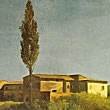
that have stood the test of time. Illustration: The Two Poplars at the Villa Farnese by Pierre-Henri Valenciennes. c.1783. Musée du Louvre. Paris. A simple split analogous scheme, the color purities muted to give a brooding or meditative air. Company | Credits | Disclaimer | Email |
|||||
Copyright 2003 2004 2005 2006 LitLangs. All Rights Reserved |