Painting on Light Grounds
Two very distinct methods come under this heading: the Pre-Raphaelite approach where the white ground acts as a reflective base for jewel-like glazes, and the direct painting approach where paint is applied so as to entirely and opaquely cover the original white ground.
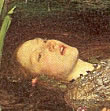
Pre-Raphaelites
Here a stained-glass effect is achieved by applying many colored glazes over a drawing. Body color is kept to a minimum, just sufficient to capture highlights, and to control the floating effect of glazes.
Steps:
1. Transfer a precise, delicate pencil drawing onto the white ground.
2. Apply a guide to shading with faint colored glaze.
3. Dry.
4. Apply overlapping colored glazes, working wet into wet where necessary.
5. Dry.
6. Retouch shadows.
7. Dry.
8. Apply stronger-colored glazes, oiling out previous surface if too dry to take new glaze.
9. Dry.
10. Add detail in finishing glazes, including white in thin glazes to areas where highlights have been lost.
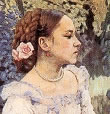 A
style popular since the late 19th century where
the paint is applied opaquely to completely cover
the ground. Painting commonly proceeds by stages,
allowing drying between stages, but may be completed
in the one session given the right skill and circumstances.
White is used throughout, plus thin washes in the
lower stages, but glazing is absent.
A
style popular since the late 19th century where
the paint is applied opaquely to completely cover
the ground. Painting commonly proceeds by stages,
allowing drying between stages, but may be completed
in the one session given the right skill and circumstances.
White is used throughout, plus thin washes in the
lower stages, but glazing is absent.