Aims in Painting Landscapes
Landscapes have grown in popularity over the centuries, and now display a greater variety and perhaps originality than any other genre. Landscapes afford the painter the refreshment (sometimes the bracing challenge) of working out of doors, and the viewer with the opportunity of renewing contacts with natural surroundings.
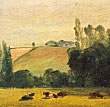 That
brings us immediately to the shortcomings of so
much amateur landscape painting. Over-conscientious,
uninspired, derivative — these are not the
main problems. It is the revitalizing, underlying
vision that is lacking.
That
brings us immediately to the shortcomings of so
much amateur landscape painting. Over-conscientious,
uninspired, derivative — these are not the
main problems. It is the revitalizing, underlying
vision that is lacking.
Originality can certainly be overdone, but what galleries and museums look for generally is a freshness and depth of vision that renders the world in meaningful and significant terms that hadn't been apparent before. Bold liberties with color and perspective? Perhaps, but more important is a thoughtful and probing honesty, developing a pictorial reality that is explored with and through the means of depiction. Cezanne's phrase was 'realizing my sensations before nature', and that is the first requirement: a sensitivity, an openness to how the world really appears when approached with certain preoccupations.
There are always certain preoccupations. Even the most photographic rendering of a landscape cannot avoid changing it in some degree. The vantage point has to be selected, the time of day and season chosen, the width of view adjusted. And what appears on a two-dimensional photographic plate is only a representation, not the breathing, three-dimensional reality from which the eye is always selecting, emphasizing and rearranging according to needs. A painting has an aesthetic dimension, moreover, and this involves tonal harmony, balance, points of interest, rhythmic vitality, color arrangement, etc. — the list is almost endless. Any choice among one of these will affect what is possibly with all the others, and that limitation adds another preoccupation to the painter's personal interest in a scene.
The point of this theoretical digression? To emphasize that you have a choice. However you paint a landscape, you will approach it with certain aesthetic and personal concerns. You'll be influenced by other landscapes, other painter's selections of what was worth bringing out and by what means. You cannot start with a blank mind, and nor would you want to. Earlier painters who have been any good will have something to teach you. It's really a question of where you start.
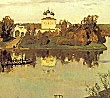
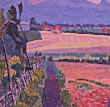
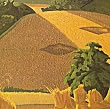 Considerable
thought and planning is needed to paint directly
with any likelihood of success. The first step is
generally sketches to work out composition, points
of interest, a balance of interesting shapes, both
positive and negative. Then comes a tonal sketch,
where the painting is commonly represented into
three tones: light, intermediate and dark (sometimes
four with the sky or water). This tonal sketch will
be completely covered by later painting, but serves
as a guide to the tonal value of that paint. The
next requirement is color harmony, and here it's
usual either to undertake a brief color sketch,
or to lay out the main colors on the palette before
applying them. Once the colors are established,
the paint is applied as freely and vigorously as
possible.
Considerable
thought and planning is needed to paint directly
with any likelihood of success. The first step is
generally sketches to work out composition, points
of interest, a balance of interesting shapes, both
positive and negative. Then comes a tonal sketch,
where the painting is commonly represented into
three tones: light, intermediate and dark (sometimes
four with the sky or water). This tonal sketch will
be completely covered by later painting, but serves
as a guide to the tonal value of that paint. The
next requirement is color harmony, and here it's
usual either to undertake a brief color sketch,
or to lay out the main colors on the palette before
applying them. Once the colors are established,
the paint is applied as freely and vigorously as
possible. We
tend of think of landscape painting as developing
through the naively charming Florentine and German
Schools, through Dutch seventeenth painting to the
English and Barbizon Schools and finally to the
Impressionists. But in fact landscape painters are
more widely distributed, and even Rubens and Poussin
produced very beautiful work. Landscape painting
techniques are therefore diverse, even among painters
of the nineteenth century. The 'painting from nature'
claims of the Impressionists indeed overlooks the
large number of their works that were conceived
and finished in the studio. That being the case,
it is study of individual landscape paintings that
is called for. Paintings with old master techniques
will often require a phased approach — sketches
to establish composition, a working up from layers
establishing the disposition of tones through applications
of color layers to modifying glazes — but there
is no reason why these techniques should not be
deployed in contemporary styles.
We
tend of think of landscape painting as developing
through the naively charming Florentine and German
Schools, through Dutch seventeenth painting to the
English and Barbizon Schools and finally to the
Impressionists. But in fact landscape painters are
more widely distributed, and even Rubens and Poussin
produced very beautiful work. Landscape painting
techniques are therefore diverse, even among painters
of the nineteenth century. The 'painting from nature'
claims of the Impressionists indeed overlooks the
large number of their works that were conceived
and finished in the studio. That being the case,
it is study of individual landscape paintings that
is called for. Paintings with old master techniques
will often require a phased approach — sketches
to establish composition, a working up from layers
establishing the disposition of tones through applications
of color layers to modifying glazes — but there
is no reason why these techniques should not be
deployed in contemporary styles.